When Something Appears in a Movie Again Film Term
A Glossary Of Screenwriting Terms & Filmmaking Definitions
By Dan Bronzite
This comprehensive glossary is provided every bit a reference for novices learning the craft of screenwriting or professionals with a limited understanding of motion-picture show-financing and production terminology. When yous are writing a script there are certain technicalities you need to understand exterior of the creative process such as script formatting and using the correct flick language, and while at first learning the "rules of screenwriting" may feel like a lark from actually writing your story and script, it won't accept long for yous to get into the groove, particularly if you let screenplay writing software such equally Movie Outline do most of the piece of work for y'all.
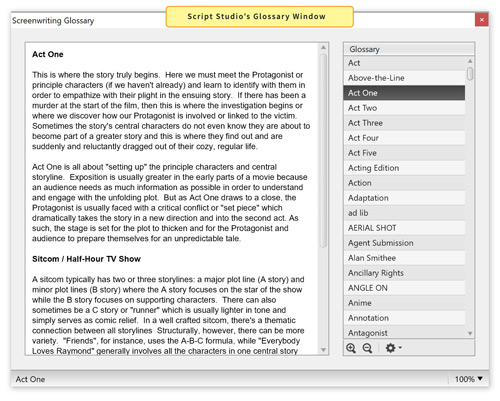
Screenwriting Terms & Filmmaking Terminology
| Action | |||||
| The scene clarification, character move, and sounds equally described in a screenplay. For example: The sounds of TYPING rise above all the rest equally MAX sits at his computer writing his essay. He stops to sigh. Looks at what he's written. Reaches over to the mouse. Highlights information technology all. And erases it. | |||||
| Aeriform SHOT | |||||
| Use only when necessary. This suggests a shot be taken from a plane or helicopter (not a crane). For case, if a scene takes place on a alpine building, you may want to have an aerial shot of the floor the activity takes place on. | |||||
| ANGLE ON | |||||
| A type of shot. This usually occurs in scenes taking identify in large settings. For case: if you lot're at a playground and little Billy is playing in the grass while his sister Jenny is playing on the structure. To get from a detail shot of Billy playing to Jenny playing you'd use "Bending ON STRUCTURE" to propose a new shot featuring Jenny. You're nonetheless in the same location, but the director knows to point the camera a dissimilar direction. Note: this is oft implied by simple scene description. Use Bending ON with good purpose. | |||||
| Dorsum to Top | |||||
| Beat | |||||
| Many scripts will use the parenthetical (beat) to interrupt a line of dialogue. A "trounce" suggests the actor should pause a moment, in silence, earlier standing the scene. "Beats" are often interchangeable with ellipses "..." | |||||
| b.g. (background) | |||||
| Used to draw anything occuring in a rear aeroplane of action (the background every bit opposed to the main activeness or attention is focused in the foreground). Always use this term in lower example initials or written in full ("groundwork"). For instance: ii people talk equally Bill and Ted fight in the b.g. | |||||
| Back to Top | |||||
| Character | |||||
| In a screenplay, the proper name appears in all caps the first time a graphic symbol is introduced in the "Action." The character'due south name can then exist written ordinarily, in the action, the rest of the script. For Example: The limo pulls upward to the curb. DAISY, an elderly woman sits in the car every bit MORGAN, the commuter, steps out and opens the door for her. Daisy is dressed in evening-wear, prepare for an Opera. Character's names e'er announced in all CAPS when speaking. For Example:
| |||||
| CLOSE ON | |||||
| See also INSERT and Shot. Close ON is a shot description that strongly suggests a close-upwardly on some object, action, or person (an expressive body office such as the face, or a fist). May also be seen as CLOSEUP / C.U. or Shut SHOT | |||||
| CLOSER Angle | |||||
| We move in for a new angle nearer to the bailiwick. This is more of an editing term, but can be mentioned in the screenplay when necessary. | |||||
| CONTINUOUS | |||||
| Sometimes, instead of Twenty-four hours or NIGHT at the end of a SLUGLINE/Location Description, you'll run into CONTINUOUS. Basically, continuous refers to action that moves from i location to another without any interruptions in time. For example, in an action movie, the hero may run from the airport final into a parking garage. The sequence may include cuts, just the audience would perceive the activeness every bit a continuous sequence of events from the final to the anteroom to the street to the garage to the second floor to a car etc. CONTINUOUS is mostly optional in writing and can exist dropped altogether. For Example: INT. Aerodrome Anteroom - DAYJANET looks over her shoulder. The MEN IN BLACK are still after her, toppling innocent passersby and sending luggage flying across the linoleum floor. Janet faces forward again and near runs smack into a nun. She apologizes and pushes through the glass doors. EXT. STREET - CONTINUOUS Janet stumbles to the curb, stopping brusque of the honking traffic. As a coach flies by, blasting her with air current, she steps out into traffic. A car SWERVES to avoid her! She GASPS, looks back. The men in black are there. Here CONTINUOUS is used for the slugline (EXT. STREET - CONTINUOUS) and represents no time passing between changes in location. | |||||
| CONTRAZOOM | |||||
| The Hitchcock zoom, also known as the contra-zoom or the Vertigo effect is an unsettling in-photographic camera special outcome that appears to undermine normal visual perception in a mode that is difficult to describe. This effect was used by Alfred Hitchcock in his moving picture Vertigo. It rarely appears in a screenplay. In the Hitchcock zoom, the setting of a zoom lens is used to adjust the field of view at the aforementioned time equally the camera moves towards or away from the subject in such a way equally to proceed the subject area the same size in the frame throughout. Thus, during the zoom, there is a continuous perspective distortion, the most straight noticeable characteristic of which is that the background "changes size" relative to the discipline. Equally the human visual system uses both size and perspective cues to judge the relative sizes of objects, seeing a perspective change without a size change is a highly unsettling event, and the emotional bear on of this effect is much greater than the description above can suggest. The Hitchcock zoom is usually used by film-makers to represent the awareness of vertigo, or to propose that undergoing a realization that causes them to reassess everything they had previously believed. A notable use of this effect is in Jaws when Principal Brody sees the mayhem in the water from the beach, or in Goodfellas, where director Martin Scorsese uses the Hitchcock zoom in a scene during the climax of the moving picture: Henry Hill (Ray Liotta) and Jimmy Conway (Robert De Niro) are sitting in a eating place, talking. Henry realizes that Jimmy is setting him up and betraying their lifelong friendship; as this happens, the perspective in the groundwork changes in a slow, gradual way. | |||||
| Clamber | |||||
| This is a term used for superimposed titles or text intended to move beyond/upward/down/diagonally on screen. For case, the text at the first of Star Wars movies "Crawls" up into infinity. Or, the written words "(clamber)" in Unforgiven. | |||||
| CROSSFADE: | |||||
| This is like a "Fade to blackness then Fade to next scene." In other words, as 1 scene fades out, a moment of black interrupts before the adjacent scene fades in. It is not to exist dislocated with DISSOLVE, since CROSSFADE ever involves a black or bare screen. | |||||
| CUT TO: | |||||
| The virtually simple and mutual transition. Since this transition is implied by a change of scene, it may be used sparingly to assist intensify character changes and emotional shifts. The transition describes a change of scene over the course of one frame. | |||||
| Back to Superlative | |||||
| Dialogue | |||||
| Very just, this is what people are supposed to say according to the script. | |||||
| Director | |||||
| The person who visualizes the motion-picture show based on the script, creates shots, suggests how the actors should portray their characters, and helps to edit the final cutting. Basically, the person in charge of putting converting a script into a movie. | |||||
| DISSOLVE TO: | |||||
| A common transition. Equally one scene fades out, the next scene fades into place. This type of transition is generally used to convey some passage of fourth dimension and is very usually used in montages such as seen in Bugsy. | |||||
| Dolly | |||||
| A mechanism on which a photographic camera can be moved effectually a scene or location. Unproblematic dollies involve a tripod on wheels. Dolly shots are moving shots. | |||||
| Dorsum to Top | |||||
| ESTABLISHING SHOT | |||||
| A shot, usually from a altitude, that shows united states of america where nosotros are. A shot that suggests location. Often used at the offset of a pic to suggest where the story takes place. For instance, if our story takes place in New York, we might use a shot of the Manhattan skyline as an establishing shot. | |||||
| EXT. | |||||
| Exterior. This scene takes place out of doors. This is mostly for producers to figure out the probable price of a picture project. | |||||
| EXTREMELY LONG SHOT (XLS): | |||||
| Means the camera is placed a very long distance from the subject or action. Generally, this term would be left out of a screenplay and left to the director to decide. Utilize only when necessary. | |||||
| Back to Top | |||||
| FADE TO: / FADE IN: | |||||
| See also DISSOLVE TO: This is ordinarily used as a Deliquesce to a Colour. Unremarkably, y'all'll see this as: BLACKFADE IN: Adjacent SCENE This usually suggests it's not the stop of the movie, simply it is the end of a major motion in the film. The "Side by side Scene" is ofttimes days, months, or years afterwards the previous scenes. Sometimes titles will appear in the black to declare a passage of time. But this transition is often a sign of a major shift in time or emotional status for the main characters. It may too be used to suggest a graphic symbol has been knocked out or killed. Fade In is also sometimes used at the outset of a screenplay. | |||||
| FAVOR ON | |||||
| A item grapheme or action is highlighted or "favored" in a shot. The focus is basically centered on someone or something in detail. Employ just when necessary. | |||||
| Feature Film | |||||
| In the olden days of picture palace, people watched a series of short films. Then, as films became longer, they would watch some curt films and one long moving picture. The long film became the master allure, hence the term feature film. Today, characteristic films are generally defined as any film at least one hr long that people pay to see. | |||||
| Wink CUT: | |||||
| An extremely cursory shot, sometimes equally curt as one frame, which is almost subliminal in effect. Too a series of short staccato shots that create a rhythmic effect. | |||||
| FLASHBACK: | |||||
| Sometimes used as a transition or at the start of slugline to denote a sequence that happened in the past. This can be followed by BACK TO Nowadays DAY if required or the writer tin use Nowadays Mean solar day as the time of mean solar day at the end of the proceeding slugline instead of just 24-hour interval. | |||||
| FREEZE FRAME: | |||||
| The picture show stops moving, becoming a nevertheless photo, and holds for a menstruum of time. | |||||
| Back to Top | |||||
| INSERT | |||||
| When a writer pictures a sure shut-up at a certain moment in the motion picture, he or she may utilize an insert shot. This describes a shot of some of import item in a scene that must be given the camera'south total attention for a moment. Inserts are mainly used in reference to objects, a clock, or actions, putting a key in a car'south ignition. For instance: if at that place'southward a clock in the room. the writer might have reason for the audience to become a expert glimpse of the clock and equally such would apply an insert shot to suggest the director get a closer shot of the clock at a particular point in the scene. Annotation: frequently; writing important objects in CAPS will convey their importance in the scene and give the director more freedom and a greater feeling of importance. Utilise inserts only when truly important. | |||||
| INT. | |||||
| Interior. This scene takes place indoors. This is mostly for producers to figure out the probable cost of a pic project. | |||||
| INTERCUT: / Intercutting | |||||
| Some scripts may use the term INTERCUT: as a transition or INTERCUT BETWEEN. At this indicate, two scenes will be shown a few moments each, back and along. For example, if Laura is stuck in her flaming firm and the fire section in on the manner, a screenplay may call for intercutting betwixt the flames closing in on Laura and the fire fighters riding across boondocks to save her. Note: this is a style that can exist written effectually with standard scene breaks. It's more to fix the reader for the upcoming slug line bonanza. | |||||
| INTO FRAME: | |||||
| See also: INTO VIEW: The audience can but encounter so much through the window of a movie screen. Utilize this term to suggest something or someone comes into the picture while the camera stays put. It'southward similar a character or object coming from off stage in the theater. For example: Forrest Gump sits on the bench. OLD Woman INTO FRAME. She sits side by side to him. | |||||
| INTO VIEW: | |||||
| Encounter besides: INTO FRAME: The audience can merely see and then much through the window of a movie screen. Utilize this term to suggest something or someone comes into the picture show while the camera pulls dorsum (pans, etc) to reveal more than of the scene. | |||||
| Iris Out | |||||
| Encounter also WIPE TO: Also written as: IRIS FADE OUT or IRIS FADE IN. Used at the end of Star Wars scripts, this term refers to a wipe from the center of the frame out in all directions. Information technology's every bit if the iris of a human eye were opening for dimly lit situations to have usa into the next scene or the ending credits as is the case with Star Wars. | |||||
| Dorsum to Top | |||||
| JUMP Cut TO: | |||||
| A transition which denotes a linkage of shots in a scene in which the appearance of real continuous time has been interrupted by omission. Imagine setting a camera down to film a person. You tape him for v minutes. But as it turns out, you accept only a one minute time limit on your project. Y'all have no special editing tools, only a couple of VCRs. Only yous realize that about of the important stuff is said in a few short moments. If you lot cut out the unimportant parts and edit together the parts you want based on a single camera angle, you lot will have what are called bound cuts. Transitions from one moment to the next inside a scene that appear jarring because they break the direct menses of filmic time and space. This transition is commonly used to show a very brief ellipsis of time. A skilful example of Jump Cuts tin be seen in the movie Elizabeth when the queen practices her speech. The jump cuts make u.s.a. disoriented and nervous along with the queen, giving the states the tension and humor of the situation as if it were an out-take reel. Bad examples of Leap Cuts would be in B-movies similar Mothra where they don't have the money to get scenes from various angles, so they cut from one important moment to the next from the aforementioned angle. | |||||
| Back to Acme | |||||
| LAP DISSOLVE: | |||||
| See as well DISSOLVE: A transition between scenes that is accomplished by fading out one shot while the next 1 grows clearer. | |||||
| Dorsum to Top | |||||
| MATCH CUT TO: | |||||
| A transition often used to compare 2 completely unrelated objects. Information technology's film's version of metaphor. This involves cutting from one object of certain color, shape, and/or motion, to another object of similar colour, shape, and/or movement. For example, a circular saw to a child's merry-go-round. A commonly studied example of match cutting comes from 2001: A Space Odyssey. The classic cutting comes towards the beginning of the pic. After the apes accept used a bone equally a weapon for gathering food, an ape throws the bone into the air. Equally information technology falls, we match cutting to a space ship conveying nuclear warheads. Both the os and the send are of similar shape and color, and both happen to be moving towards the lesser of the screen. The cut relates all of technology to the development of weaponry as it cuts out all of human history. | |||||
| MATCH DISSOLVE TO: | |||||
| Run into also Lucifer Cutting TO: / Dissolve TO: This contains similar qualities to the MATCH CUT. A match dissolve involves 2 objects of similar colour, shape, and/or movement in transition from one scene to the next. For case: if Scene A is following (tracking) an arrow whizzing through the forest, 1 might match dissolve to a tracking shot, in Scene B of a bullet whizzing through the inner city. | |||||
| Montage | |||||
| From the French term "to assemble". In motion picture, a serial of images showing a theme, a contradiction, or the passage of time. This film style became mutual in Russian federation in the early years of cinema. Russians were the first to truly use editing to tell a story. Some early examples of montage include City Symphony's and Human being With a Motion-picture show Camera. Modern day examples can be seen in Goodfellas and Bugsy. | |||||
| MOS | |||||
| Mit Out Sound (Original High german) Moment of Silence (Made up English retention device). Now hardly ever used. | |||||
| Back to Top | |||||
| O.C. / O.Southward. | |||||
| Off-Camera or Off-Screen. This is the abridgement sometimes seen side by side to the CHARACTER'S name before certain $.25 of dialogue. It means the author specifically wants the vox to come from somewhere unseen. | |||||
| Back to Top | |||||
| Pan | |||||
| Encounter Likewise: Swish Pan Camera movement involving the camera turning on a stationary centrality. Imagine standing in one spot on a cliff in Hawaii. You lot desire to blot the view so you lot, without moving your body or feet, turn your head from the left to the right. This is the same effect as a pan. | |||||
| Parenthetical | |||||
| If an actor should deliver his or her lines in a detail mode, a screenplay volition contain a description in parentheses to illustrate the point. Parentheticals should exist used simply in cases where a line of dialogue should be read in some way contrary to logic. If used besides often, actor'south and director'due south egos become injure, and things get messy. It should non be used for action decription. For Instance:
| |||||
| POV | |||||
| Point of View. The photographic camera replaces the eyes (sometimes the ears) of a character, monster, car, surveillance camera, etc. As a consequence, we get to come across the world through the sensory devices of some animate being. This can be used to bring out the personal aspects of a scene, or it can exist used to build horror and suspense. An example of horror and suspense in POV tin be scene in the opening shot of Halloween. | |||||
| PULL BACK: | |||||
| The camera physically moves away from a subject, usually through a zoom or dolly action. | |||||
| PULL FOCUS: | |||||
| The photographic camera focus changes from i object or bailiwick to some other. For example: PULL FOCUS TO INCLUDE Police Auto IN B/G. | |||||
| Button IN: | |||||
| The camera physically moves towards a subject field. | |||||
| Dorsum to Top | |||||
| REVERSE ANGLE | |||||
| Often used to reveal things for comic or dramatic effect. Could be described as a counter POV shot. Basically, the script suggests the camera come around 180 degrees to get a shot from the "other side" of a scene. For example, in the There's Something Most Mary script, Tucker is playing a joke on Mary in her office in 1 scene that the writers didn't want to reveal correct away. They use a Contrary Bending to show that he'southward got two tongue depressors in his upper lip to stand for teeth. This reverse angle is used for comic issue. | |||||
| Back to Top | |||||
| Scene | |||||
| An upshot that takes identify entirely in 1 location or time. If nosotros go exterior from inside, it's a new scene. If we cut to five minutes later on, it's a new scene. If both, information technology's a new scene. Scenes can range from 1 shot to infinity and are distinguished by slug lines. | |||||
| Shooting Script | |||||
| This is the truly terminal draft used on ready by the production people, actors, and director to make the picture from the screenplay. | |||||
| Shot | |||||
| Ane paradigm. If there's a cut, you lot've changed shots. Shots can range from carve up seconds to several minutes. Shots are more often than not chosen by the director although the writer can use capital letters to advise where the camera should be. When a writer absolutely must take a certain shot at a sure moment in a flick, he has a few options each described in detail elsewhere in this list: INSERT, ANGLE ON, and CLOSE ON. | |||||
| Slug Line | |||||
| The text in all CAPS at the showtime of a scene that briefly describes the location and time of twenty-four hour period. For example: INT. JIMMY'S BEDROOM - NighttimeAnnotation: sometimes sluglines are abbreviated to something as simple as "Later on" or "BEDROOM" to maintain the pace and catamenia of a sequence. | |||||
| Boom Cut TO: | |||||
| An especially abrupt transition. This style of cut is usually used to convey devastation or quick emotional changes. For example: If you were writing a horror movie but wanted to lighten the gore at the beginning, y'all might have: EXT. FOREST - NIGHT A YOUNG GIRL races abroad from her tormentor but then trips and falls. The KILLER enters the woods clearing, taking a moment to savor this death. The Girl shakes her head, equally if begging for the killer to change his mind. Merely no, he closes in, a black cloaked arm raising the knife into the air. The knife catches the moonlight for merely a moment before it races downwards. EXT. HIGH SCHOOL COURTYARD - Day It's a bright and beautiful morning and a bunch of kids wander the courtyard on their way to class. The sudden shift from a dark forest to a brilliant schoolyard on the beginning stab would convey the distress of the murder without showing it. Annotation: this transition is often a director's choice. As a author, apply this sparingly if at all. | |||||
| Spec Script / Screenplay | |||||
| If a writer finishes his/her own screenplay exterior the studio system (it isn't an assignment) so sends it to the studios for consideration, it is a spec script. | |||||
| Carve up SCREEN SHOT: | |||||
| The space of the frame is separate into two, three, or more than frames each with their ain field of study. Unremarkably the events shown in each department of the split screen are simultaneous. But Split screen can also be used to show flashbacks or other events. For instance, two people are talking on the phone. They're in unlike locations, but y'all wish to testify the reactions of both simultaneously. Separate Screen is used prominently in 24 to bear witness simultaneous action and events unfolding. | |||||
| Steadicam | |||||
| A photographic camera congenital to remain stable while being moved, usually by human hands. Occasionally, seen in scripts to suggest a handheld shot be used in a scene, although a steadicam is smoother than a regular handheld shot and as such produces a unlike result. | |||||
| STOCK SHOT: | |||||
| Footage of events in history, from other films, etc. Basically, annihilation that's already filmed and y'all intend to exist edited into the movie. For example, the Austin Powers movies utilize stock footage for comic effect. Some old B films use stock footage to keep their budgets depression. | |||||
| SUPER: | |||||
| Abbreviation for superimpose. The superimposition of one matter over some other in the same shot. Sometimes TITLES are superimposed over scenes. Or a face can exist superimposed over a stream-of-consciousness montage shot. | |||||
| Swish Pan | |||||
| A quick snap of the photographic camera from one object to another that blurs the frame and is frequently used equally a transition. Sometimes called a Wink PAN. Cuts are often hidden in classy pans, or they tin can exist used to disorient or stupor the audience. | |||||
| Back to Peak | |||||
| TIGHT ON | |||||
| A shut-upwards of a person or thing used for dramatic effect. A tight frame encloses a subject with very piffling space surrounding information technology. Not in common utilise. Use only when necessary. | |||||
| TIME Cutting | |||||
| When you want to cut to after in a scene, you lot have the choice of writing Time CUT every bit the transition. For example, if two people walk into a restaurant and their conversation is important at start then veers off into topics not important to your story, so you lot might want to time cut from the drinks to the main course and and then again to paying the bank check. | |||||
| Tracking Shot (Track, Tracking, Travelling) | |||||
| A tracking shot involves a photographic camera post-obit a person or an object. As long equally the camera isn't locked down in place by a tripod, for example, and is following (tracking) a subject field, then it'due south a tracking shot. For skilful examples of tracking shots, lookout the one have episode of The X-Files, any episode of ER or the beginning shots of Touch of Evil and The Player. | |||||
| Trailer | |||||
| In the olden days of movie theater, the advertisements for upcoming attractions were usually played later the end of the movie. Hence, they became known as trailers. But, every bit credits reels take grown in size over the years, audiences would ofttimes exit earlier watching these advertisements and "trailers" became "previews." But the proper name is nevertheless in mutual employ. A trailer is a theatrical advertizing for an upcoming motion-picture show attraction. | |||||
| Transition | |||||
| These depict the way in which i scene becomes the adjacent. Used appropriately, these tin can exist used to convey shifts in grapheme development and emotion. In other words, a CUT TO: is non required at every scene change. Some major transitions include CUT TO:, DISSOLVE TO:, MATCH Cut TO:, JUMP CUT TO:, SMASH Cutting TO:, WIPE TO:, and FADE TO:. Occasionally a writer will make up his own transition. In these cases, the transition is commonly self-divers (such as BRIGHT WHITE FLASH TO: suggests whiteness will fill the screen for a brief moment as we laissez passer into the next scene). | |||||
| Back to Top | |||||
| Five.O. | |||||
| Voice Over. This abbreviation frequently appears beside a Graphic symbol'S name before their dialogue. This ways the character voices that dialogue simply his or her moving lips are not present in the scene. Voice-over is generally used for narration, such as in the beginning of The Mummy. Or a character's inner thoughts said out loud such that merely the audience volition hear. | |||||
| Back to Top | |||||
| WIPE TO: | |||||
| A transition in which one scene "wipes away" for the next. Imagine Scene A is water and Scene B is the substance underneath. A wipe would await similar a squeegee pulling Scene A off of Scene B. These normally suggest a passage of fourth dimension from one scene to the next. The most common and obvious example of wipes is in the Star Wars franchise. | |||||
| Back to Top | |||||
| ZOOM: | |||||
| The image seems to shut in on a person or object making the person or object announced larger (or smaller) on screen. Technically, the lens mechanically changes from broad bending to telephoto or vice versa. Notice and recognize the deviation between a zoom and a push in (camera moves closer to subject). Employ zoom only when necessary. | |||||
| Back to Top | |||||
Download a Gratuitous Demo of Script Studio to run into how its powerful screenplay formatting, character development and story structuring tools can help you make a amend script!

Source: https://www.movieoutline.com/articles/a-glossary-of-screenwriting-terms-and-filmmaking-definitions.html
0 Response to "When Something Appears in a Movie Again Film Term"
Post a Comment